What is Real Estate?
Real estate is real property that consists of land and improvements, which include buildings, fixtures, roads, structures, and utility systems. Property rights give a title of ownership to the land, improvements, and natural resources such as minerals, plants, animals, water, etc.
Types of Real Estate
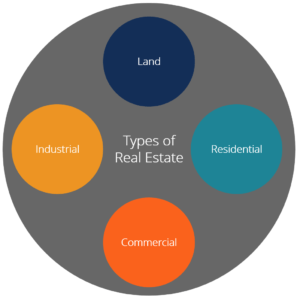
There are several types of real estate, each with a unique purpose and utility. The main categories are:
- Land
- Residential
- Commercial
- Industrial
For anyone looking to understand how the industry works and what each of the major categories represents, the explanations below will be a helpful guide.
#1 Land
Land is the baseline for all types of real property. Land typically refers to undeveloped property and vacant land. Developers acquire land and combine it with other properties (called assembly) and rezone it so they can increase the density and increase the value of the property.
#2 Residential
Residential real estate consists of housing for individuals, families, or groups of people. This is the most common type of estate and is the asset class that most people are familiar with. Within residential, there are single-family homes, apartments, condominiums, townhouses, and other types of living arrangements.
#3 Commercial
Commercial property refers to land and buildings that are used by businesses to carry out their operations. Examples include shopping malls, individual stores, office buildings, parking lots, medical centers, and hotels.
#4 Industrial
Industrial real estate refers to land and buildings that are used by industrial businesses for activities such as factories, mechanical productions, research and development, construction, transportation, logistics, and warehousing.
Examples of Real Estate
Now that we’ve outlined the four main categories, let’s explore some specific examples of different types of real property.
- Single-family dwelling – Any home designed for only one family
- Multi-family dwelling – Any group of homes designed for more than one family
- Attached – Any unit that’s connected to another (not freestanding)
- Apartment – An individual unit in a multi-unit building. The boundaries of the apartment are generally defined by a perimeter of locked or lockable doors. Often seen in multi-story apartment buildings.
- Multi-family house – Often seen in multi-story detached buildings, where each floor is a separate apartment or unit.
- Condominium (Condo) – A building with individual units owned by individual people.
- Detached house – A free-standing building not connecting to anything else (a stereotypical “home”)
- Portable house – Houses that can be moved on a flatbed truck
- Mobile home – A vehicle on wheels that has a permanent residence attached to it
- Villa – A building with only one room and typically a steep pointy roof
- Hut – A dwelling typically made of raw materials such as bamboo, mud, and clay
Overview of Real Estate Industry
Let’s explore how the industry works and what the major jobs and careers are. The real estate industry can be divided into several different areas:
- Development
- Sales and marketing
- Brokerage
- Property management
- Lending
- Professional services (law, accounting, etc.)
Let’s look at each of these six areas of the industry in more detail.